How to Connect Google Reader Shares to Facebook via Hootsuite

I have a Facebook Fan page, but I rarely post there because they make it so difficult to do so. There is no bookmarklet that facilitates this action. I’m sure there is some obscure Facebook application that might help with this, but I haven’t found it yet. My only recourse has been to actually visit the page and cut/paste a link. Very time consuming and inefficient if you’re working at the level I am when it comes to social media.

I came across a discussion on piping reader shares into Twitter using Reader2Twitter. This got me thinking about Hootsuite‘s RSS/Atom feature, which lets you pipe a feed through Hootsuite and out to the social networks you choose. Rather than have to deal with yet another 3rd party web application, why not just use an existing feature in an application I already use daily?

Adding Your Facebook Fan Page to Hootsuite

The first step is to connect your Facebook Fan Page to Hootsuite. I actually stumbled across this by accident in simply trying to get my GReader shares into Twitter. Note that once you have done this, you can easily post updates to your Fan Page from within Hootsuite on a per-update basis, making it simple to keep your page updated with fresh content for your fans.

  • Click Settings at the bottom of Hootsuite
  • Click the Social Networks tab and then Add Social Network  on the right
  • In the popup, choose Pages under Facebook to connect your page to Hootsuite
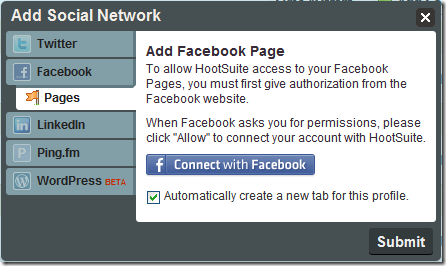
FanPageHoot

Adding Your Google Reader Shared Items Feed

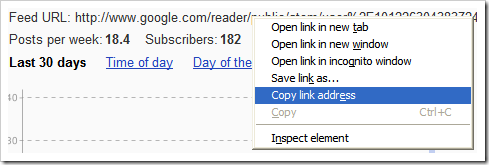
Adding your Shared Items feed is simple. The hardest part is finding the actual feed link. I found my Shares page from my Google Profile (your Google Profile is here). It should be listed as one of your websites. You should see the actual feed link on the right side of that page, just copy it. Alternately, you can go into Google Reader, click Shared Items on the left, and then show details on the right. The feed URL should appear, right-click and copy it.
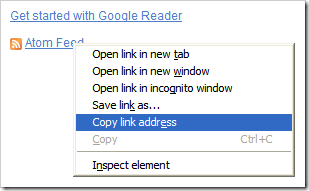
GFeedLink

GFeedLink2


Back in Hootsuite and under Settings choose the RSS/Atom tab and Add New Feed. Paste your shared items feed URL into the first text box and decide how often you want the feed checked and how many tweets you want Hootsuite to send out each time. Be conservative here. If you send any more than a couple of tweets out at a time, you will look like a spammer or a n00b. Make sure you choose which accounts you want updates from this feed sent to at the bottom. Check the screenshot below to see how I have mine setup.
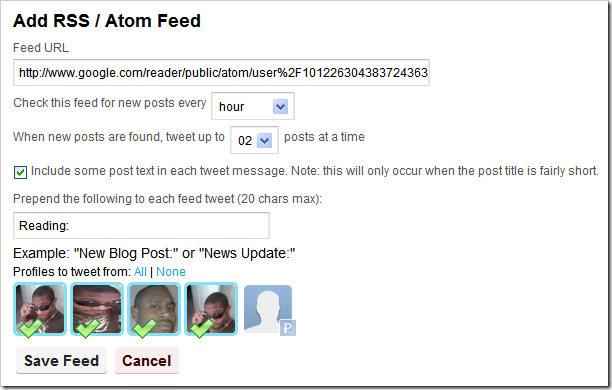
HootsuiteRSS

If you need any further assistance or clarification, please comment here. I would appreciate your feedback and would be happy to help. Also, if you have a better or alternate way of doing this, I’d love to hear it.
Google Buzz, PleaseRobMe, and Privacy Scare Tactics

Buzz

With Google Buzz recently launching inside of your Gmail, many people immediately became concerned about their privacy. The primary reason being that there was a social component inside their email inbox, a place normally reserved for private discussion.

The other concern that arose was the way Google built your network. Most social networks are built, brick-by-brick, by the user. This is a huge pain to repeat every time you join something new. What Google did was use the wealth of information it already has on your to build your network for you and get you started. What they also did was make this new friend’s list visible to the public on your Google Profile page, just like any other social network.

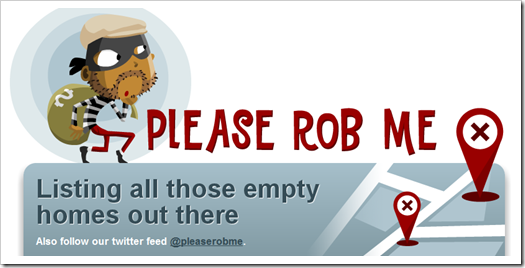
Buzz also has location sharing available, which is a whole other can of worms when it comes to privacy concerns. Which brings us to the website PleaseRobMe.com. It’s a website that monitors location-based checkins and lets the world know when you are not home. Does that scare you?

Regardless of the various arguments, anecdotes, and opinions that can be expressed by these privacy “issues,” there is one thread that remains constant and true:

These so-called privacy concerns are just scare tactics to boost traffic

Think about this logically for a moment. Do your contacts on any social network immediately imply any connection between you and another individual besides the fact that you interact with them on that social network? If my Buzz contacts include Robert Scoble, Louis Gray, P. Diddy, and Barrack Obama, does that mean anything? The answer to both of these questions is Absolutely Not. In order to be afraid (and yes, it is only fear that motivates privacy concerns) of my contacts being made public, I have to make the assumption that someone besides me can make sense of that data. My contacts alone mean nothing to an outside observer.

PleaseRobMe

The same goes for PleaseRobMe. I check in at the grocery store. Suddenly, the world knows I’m not at home. Oh no! Now I’m gonna get robbed because I’m not home. Nevermind the fact that I have a family, a security system, several dogs, a platoon of security ninjas, and nosy neighbors. Regardless of whether the world knows I’m home or not, a potential robber still has to go through the same procedure of casing the house and whatnot before they can actually rob me successfully. Again, in order to be worried about this data being public, I have to make assumptions.

I do not mean to imply that location sharing has never led to a robbery. I also don’t mean to imply that having a public contact list has ever resulted in some other type of misfortune, but these are edge cases. These situations are not the norm. Also, people were being robbed way before location sharing existed.

So, before you go getting excited about the latest privacy scare as it relates to technology, take a moment and think about it. Is it a legit privacy concern, or is it just something being drummed up by the media or the blogosphere to boost their traffic?

h/t Hutch Carpenter

Get Bookmarklets in Chrome Applications with Shortcut Manager

I accidentally stumbled across  this in looking at the Quix bookmarklet. I’m a heavy bookmarklet user, especially after switching to Google Chrome. One of the bookmarklets I use the most is for the PassPack password manager. This allows me to login to any website with a single click.

The problem is that, if I’m using an application shortcut or pop-up window, I can’t access my Passpack bookmarklet or any of my bookmarks. Then, I came across the Shortcut Manager Chrome extension. It allows you to assign a shortcut key to a block of javascript code. So, I can assign a key sequence that executes any of my bookmarklets. The steps are simple:

  1. Install the Shortcut Manager extension
  2. Right-click the Shortcut Manager icon and open the Options
  3. In the Shortcut Key box, press the keys you’d like to assign (I chose Ctrl+Shift+l)
  4. Choose the Execute Javascript option below
  5. Paste the javascript code for your Passpack bookmarklet into the text box
  6. Add a description

Now, you can hit Ctrl+Shift+l to run your Passpack bookmarklet inside of any Chrome window. This works in App shortcuts as well as in any popup windows (which I encounter with Posterous all the time). If you’re looking for a geekier solution, check out my Bookmarklet Key Bindings AHK script.


Reblog this post [with Zemanta]

Thinking Bigger: Living in Your New House

Ranch style home in North Salinas, California

Image via Wikipedia

This is a Sponsored Post written by me on behalf of Coldwell Banker. All opinions are 100% mine.

Many people have developed a culture of thinking small. We lament about stuff we can’t afford. We talk about how broke we are. We make jokes about how messed up our credit is and we would never be able to do something like buy the car of our dreams or purchase a house. Thinking in this way is a downward spiral, a race to the bottom. Even when you’re joking, thinking negative brings you negativity.

One example of thinking bigger can be found in the concept of buying a home. It seems like such a huge and difficult thing to do, especially if you’re not confident in your credit history or feel like you don’t make enough money. Just as with anything else in life, though, you won’t know unless you try.

“Not bothering to try is the same as failing, except that you don’t learn anything from it.”

With the 2010 Homebuyer Tax Credits, this is even more incentive to step out and try something you didn’t think was possible. This federal income tax credit has been extended and expanded to include homeowners who wish to “move on” after 5 years of living in their current property, as well as first-time homebuyers. If you have one of these properties, make sure you get covered by property and casualty insurance so they can cover you just in case of any disasters or damages caused by other people. If you end up finding a broker, make sure they use this p&c software.

“Live in your new house mentally until it takes form around you physically” –Wallace D. Wattles

If you make less than $125,000 as an individual or $225,000 as a family or have lived in your current home consecutively for 5 of the last 8 years, you are eligible to receive a tax credit ranging from $6,500 to $8,000. To say it a different way, the federal government wants to pay you thousands of dollars for getting a new house and stimulating the economy. You have to act now as there may not be another extension. You need a written, binding contract by April 30, 2010 (close by June 30, 2010.)

“Shoot for the moon. Even if you miss it you will land among the stars.” –Les Brown

Start thinking bigger and stop sabotaging your own success before you ever get started.

Visit my sponsor: 2010 Homebuyer Tax Credits

Reblog this post [with Zemanta]